A beautiful pit that is too large, too hard to move, or too demanding for a normal weekend can become a lawn ornament. A modest kettle, used well, can turn out better barbecue than an expensive cooker used carelessly. This guide covers the main types of cooker — what each one is good at, and where it falls short.
Offset smokers
An offset smoker has a firebox on one side and a cooking chamber beside it. Heat and smoke move from the firebox into the chamber and out through a stack. This design is strongly associated with Texas-style barbecue and traditional stick-burning.
Offset smokers reward attention. You build a small clean fire, feed it regularly, and manage airflow. A heavy offset made from thick steel will hold heat more steadily than a thin one.
- Excellent wood flavor and strong bark development.
- Large cooking surface.
- Traditional fire management.
- Requires regular attention — not ideal for sleeping through an overnight cook.
- Cheap models leak and swing in temperature.
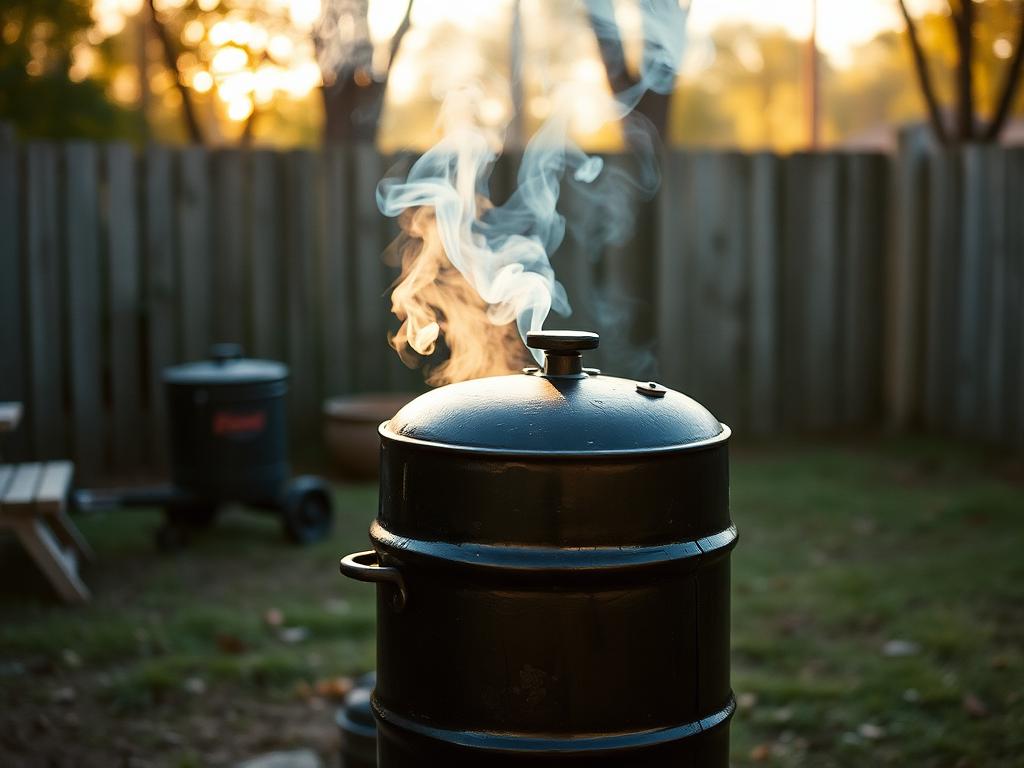
Bullet and water smokers
Bullet smokers are vertical cookers with charcoal at the bottom, food above, and often a water pan between the fire and the meat. They are efficient, compact, and capable of excellent barbecue. The water pan helps stabilize temperatures and adds a buffer between direct heat and the food.
These smokers are especially good for ribs, pork shoulder, chicken, turkey breast, and smaller briskets. They do not require the same level of fire tending as an offset, but they still teach the fundamentals of vents, charcoal, smoke wood, and airflow.
Kettle grills as smokers
A kettle grill is one of the most versatile outdoor cookers. With the coals banked to one side and the meat placed on the other, it becomes a small smoker. Add a drip pan, control the vents, and use a few chunks of hardwood for smoke. For many backyard cooks, this is the smartest first step into barbecue.
Kettles are especially good for ribs, chicken, small pork shoulders, sausages, tri-tip, and hot-and-fast brisket experiments. The limitation is space and burn time, not flavor.
Vertical cabinet smokers
Vertical cabinet smokers can run on charcoal, wood, pellets, gas, or electricity. Their main advantage is capacity in a compact footprint. They are popular with people who cook for groups, cater events, or want shelves of ribs, sausage, poultry, or pork. Insulated cabinets hold heat well and can be efficient in cold weather.
Pellet smokers
Pellet cookers feed compressed wood pellets into a burn pot using an electric auger. A controller manages temperature. Their strength is convenience — they make barbecue accessible to people who do not want to manage a live fire for hours.
Pellet smoke is usually milder than a stick burner. Some cooks love that cleaner, lighter profile; others want a more assertive wood-fire flavor. Pellet cookers also require electricity and regular cleaning of the burn pot.
Brick pits and permanent pits
Brick pits have a special romance, but they should be planned carefully. Before building one, think about airflow, fire access, cleanout, drainage, cooking height, and weather exposure. A permanent pit is hard to modify later. Use fire-safe materials, allow for ash removal, and make sure the cooking chamber can be managed without leaning into smoke and heat.
How much cooking space do you need?
Think in food, not square inches. For most backyard cooks:
- A kettle or small bullet smoker handles family meals.
- A medium bullet or cabinet handles gatherings.
- A large offset or cabinet is better for repeated large cooks.
- A permanent pit only makes sense if you cook often and know your style.
Thermometers and basic tools
You do not need many tools, but a few matter:
- A reliable digital instant-read thermometer.
- A pit thermometer at grate level.
- Heat-resistant gloves and long tongs.
- A charcoal chimney if you cook with charcoal.
- A cutting board large enough for brisket or ribs.
- A sharp slicing knife.
Built-in lid thermometers are often inaccurate because they measure dome temperature, not grate temperature. Use them as a rough reference, not as the final truth.
"Buy for your actual life. Learn airflow, learn your fuel, cook the same cuts repeatedly, and change one variable at a time." — old porch advice← Back to the Archive